24.07.2025
UCB1: a superior-performing pistachio rootstock
Generally, pistachios represent a crop that is tolerant to drought and soil salinity. However, irrigation and other factors can increase the yield of the pistachio tree or the quality of the fruit. Additionally, there are varieties that may be more drought-resistant but less tolerant to cold; or are tolerant to certain diseases, but more susceptible to frosts.
To improve the adaptation of the pistachio tree to various environments and boost the crop yield, rootstocks are used. The rootstock is the lower part of the plant that provides the root system (set of roots) and a portion of the stem. It is the element into which the graft is inserted, which is the top part that will flower and bear fruit.
Agróptimum: rootstock solutions
Just as the graft (commercial variety of pistachio, female or male) is selected for fruit quality, productivity, market preference, etc., the rootstock must also be chosen, considering its vigor and resistance to diseases, climate, and soil. Then, upon successfully completing the graft, a tree with the best of both parts is formed.
In this post, we present the pistachio rootstock UCB1. A vigorous plant that allows achieving the desired profitability in the cultivation project.
The UCB1 gets its name from the abbreviation “University of California Berkeley hybrid pistachio rootstock number #1.” It is a plant created by the Department of Plant Pathology at this prestigious university, through hybridization (crossing) between the Pistacia Atlantica (female) and Pistacia Integerrima (male) varieties, which were previously selected.
Currently, the UCB1 is the most advanced rootstock. It has a rooting percentage greater than 90%. It is the most used in the United States, the country with the highest pistachio production per hectare planted. It is even the most popular in long-established producing countries like Iran.
It is a hybrid plant designed to be used only as rootstock; by itself, it will not produce fruit.
It exhibits superior characteristics that allow it to resist diseases and provide maximum efficiency in both irrigated and dryland crops. Its main characteristics are:
The multiple characteristics of the UCB1 allow it to offer numerous benefits, both agronomic and economic. For example, this pistachio rootstock:
 Accelerates production: generally, trees grafted with UCB1 begin producing between 3 and 4 years after being planted. This advance in production allows for early profitability of the investment made.
Provides uniformity to plantations. This means that all plants will have the same height and will enter production in the same period.
Facilitates achieving high yields. The UCB1 rootstock accelerates the start of production, making it possible to obtain an average harvest of pistachios in less time.
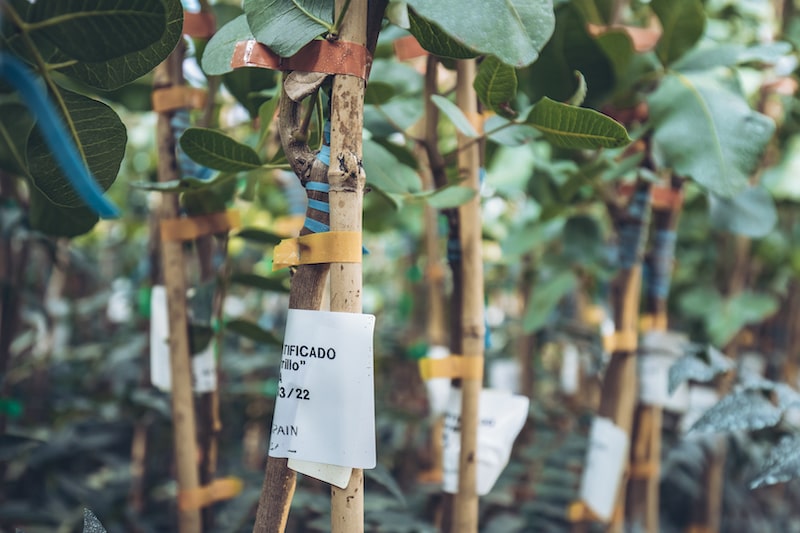
Propagation methods for UCB1 rootstock
The UCB1 rootstock can be cloned or propagated through seeds:
This is a asexual propagation produced in the laboratory, where tissues of UCB1 rootstocks are cultivated. For this, a population of rootstocks with the desired characteristics is selected in advance. This method allows for rapid multiplication of the plants. However, this method is not advisable as the plant does not develop a taproot and is also susceptible to many diseases.
This is a sexual propagation in which UCB1 seeds cultivated in certified trees that follow the same protocols and controls as the University of California are used. Special procedures of manual pollination are employed to produce the seed. Moreover, the greenhouse is equipped with special protections to prevent undesirable hybridizations. Its root system is characterized by having a taproot that allows it to penetrate deeper into the soils, achieving better adaptation, anchorage, and access to water and nutrient reserves.
It is possible to acquire grafted pistachio plants from a nursery, whose process has been carried out by expert professionals. You can also acquire UCB1 rootstocks, transfer them, plant them, and perform the graft in the own terrain or field.

Agróptimum: grafted pistachio plants in nursery.
We always recommend acquiring the grafted pistachio plant, because it eliminates the risks associated with the grafting process. This represents peace of mind for the producer and offers the following benefits:
Maximum reliability in graft take: they are developed under strict controls and free from threats, so

14.10.2026
9.10.2026

7.10.2026

1.07.2026