24.02.2026
Before the 2000s, Spanish pistachios were largely unknown.
There were barely any plantations of this crop, and those that did exist were grown as a hobby or a small personal experiment by a handful of bold farmers.
Processing facilities for the crop were practically non-existent, and very little was known about how to manage it. For most farmers, pistachios were seen more as a curiosity than as a real agronomic alternative.
A medida que fueron entrando los 2000, se comenzó a popularizar el cultivo del pistacho.
Durante este periodo aparecieron las primeras explotaciones de pistacho español con un enfoque agronómico relativamente serio. Sin embargo, la falta de conocimiento técnico sobre el cultivo hizo que se relegara a tierras de baja productividad y siguiendo prácticas agronómicas muy antiguas y genéricas.
Aunque esto condicionó la viabilidad del cultivo, esta etapa sirvió para que el pistacho penetrase en España y comenzara a plantearse como una alternativa rentable dentro de los cultivos leñosos.
During this period, pistachios became established as an alternative to other traditional woody crops in Spain, such as olive trees and vineyards.
Farmers were beginning to see the potential of the crop, and the first large-scale pistachio plantations had already started to appear across the country.
At this time, Spanish pistachios experienced explosive growth. In 2011, an estimated 4,300 hectares were dedicated to pistachio cultivation. By 2020, this figure had reached 50,000 hectares.
This rapid expansion was accompanied by the development of new, more professional processing facilities, as well as the emergence of new companies specialising in pistachio project development.
During this period, new rootstock and productive varieties also began to be explored.
This was when the UCB#1 rootstock, the Sirora variety and the Larnaka variety arrived in Spain; varieties that would go on to become key pillars of Spanish pistachio cultivation.
During this period, Spain became Europe’s leading pistachio producer.
The cultivated area grew to 79,000 hectares in 2024, consolidating Spain’s position as the fifth-largest producer worldwide. It is estimated that most of the hectares planted during this period are still in their juvenile stage, with explosive growth in national production expected from 2028 onwards.
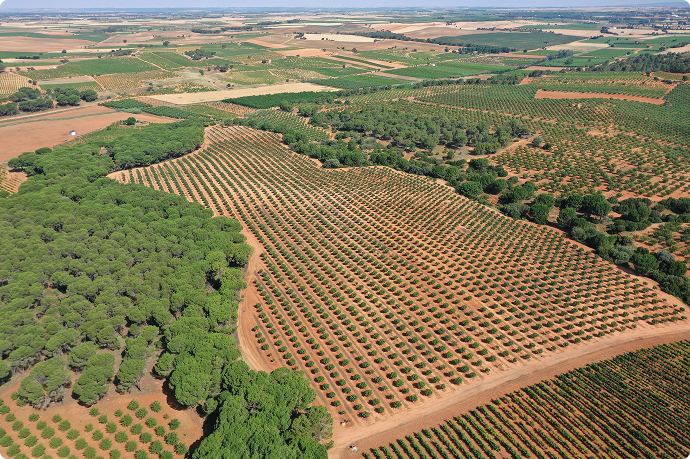
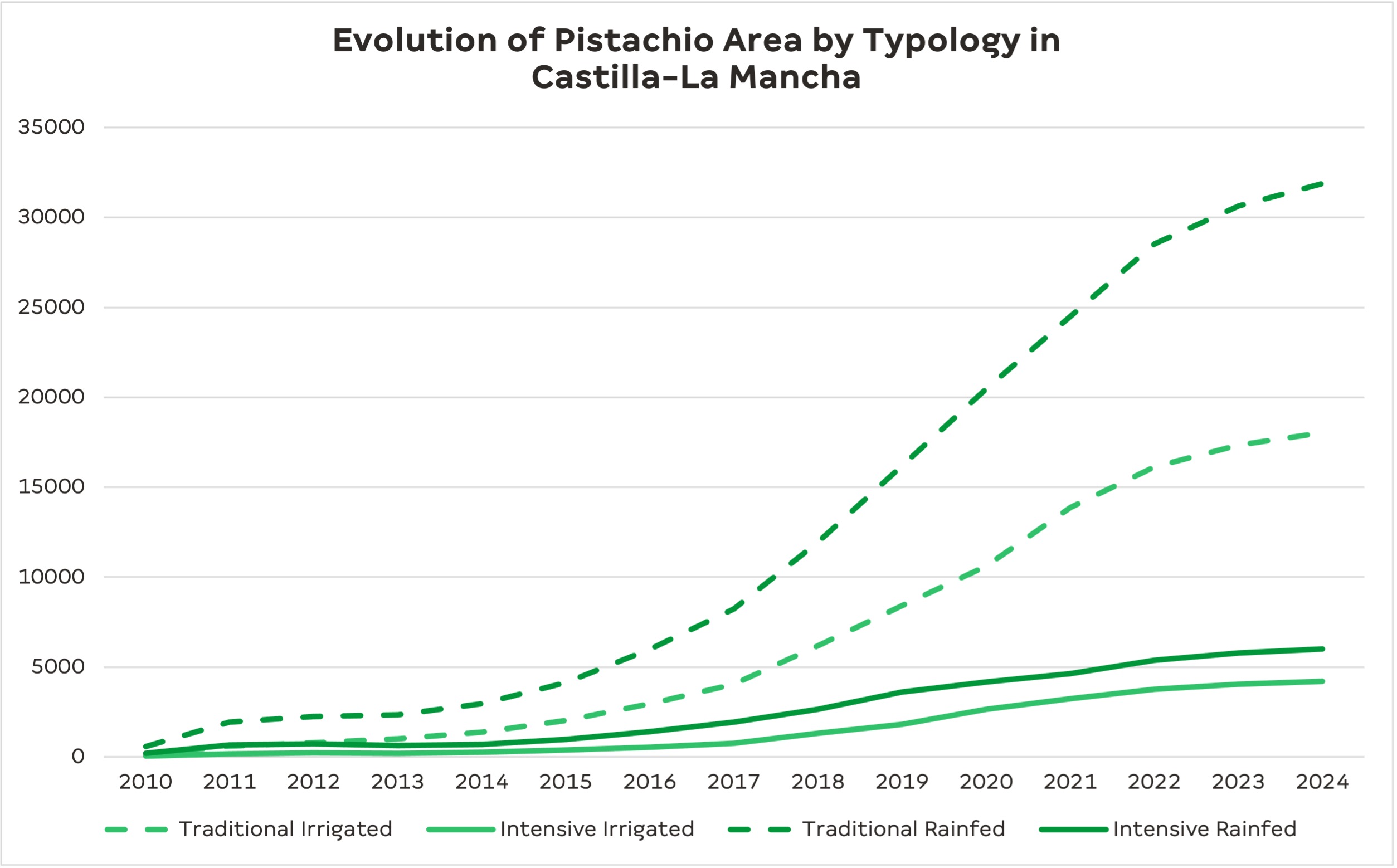
Actualmente, el grueso de la producción nacional se localiza en la región de Castilla-La Mancha, donde se produce cerca del 80 % del pistacho Español.
En 2026, la producción de la región superaba las 11.000 toneladas anuales, de las cuales 4.000 fueron de pistacho ecológico. La región destaca por la abundancia de fincas en régimen de secano, aunque también hay fincas de regadío.
Esta región es la más antigua del país, por lo que la mayoría de variedades cultivadas son antiguas. Destacan kerman injertada en cornicabra, seguido de avdat ingertado en cornicabra.
Sin embargo, las nuevas plantaciones de la región están utilizando nuevas variedades más productivas y con un menor tiempo de entrada en producción.
La combinación de sirora con el portainjerto UCB#1 está ganando mucha popularidad en la región gracias a su mayor resistencia al cambio climático, mayor productividad y mayor precoz.
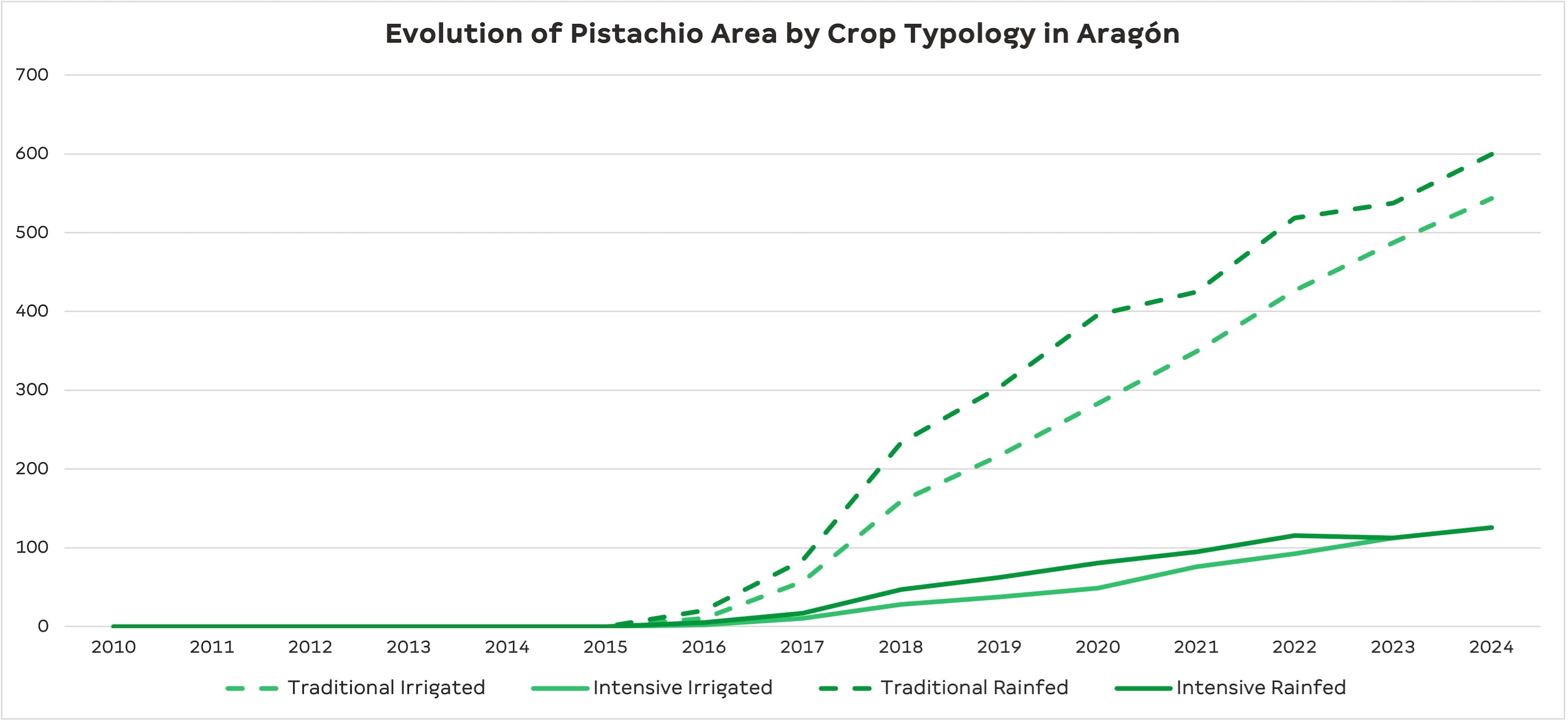
Aragon is the region with the greatest potential for pistachio cultivation in Spain. It is an area that meets the crop’s heat and chilling requirements, while also offering very high irrigation availability. In addition, the region’s water is of excellent quality and its soils are highly fertile.
This makes it possible to establish pistachio plantations under intensive planting systems, with extremely high productivity per hectare.
Aragon dedicates 83,000 hectares to nut cultivation, of which only 1,400 hectares are currently used for pistachios.
However, investment funds are aware of the region’s highly favourable conditions and, looking ahead to 2028, are expected to begin investing significant capital in the region’s agricultural sector.
Due to the high productivity of Aragon’s farmland, nut growers have not needed to look for alternative crops such as pistachios, which helps explain the slower adoption of this crop in the region.
This is a situation that is expected to change in the coming years as pistachio cultivation gains popularity in the area.
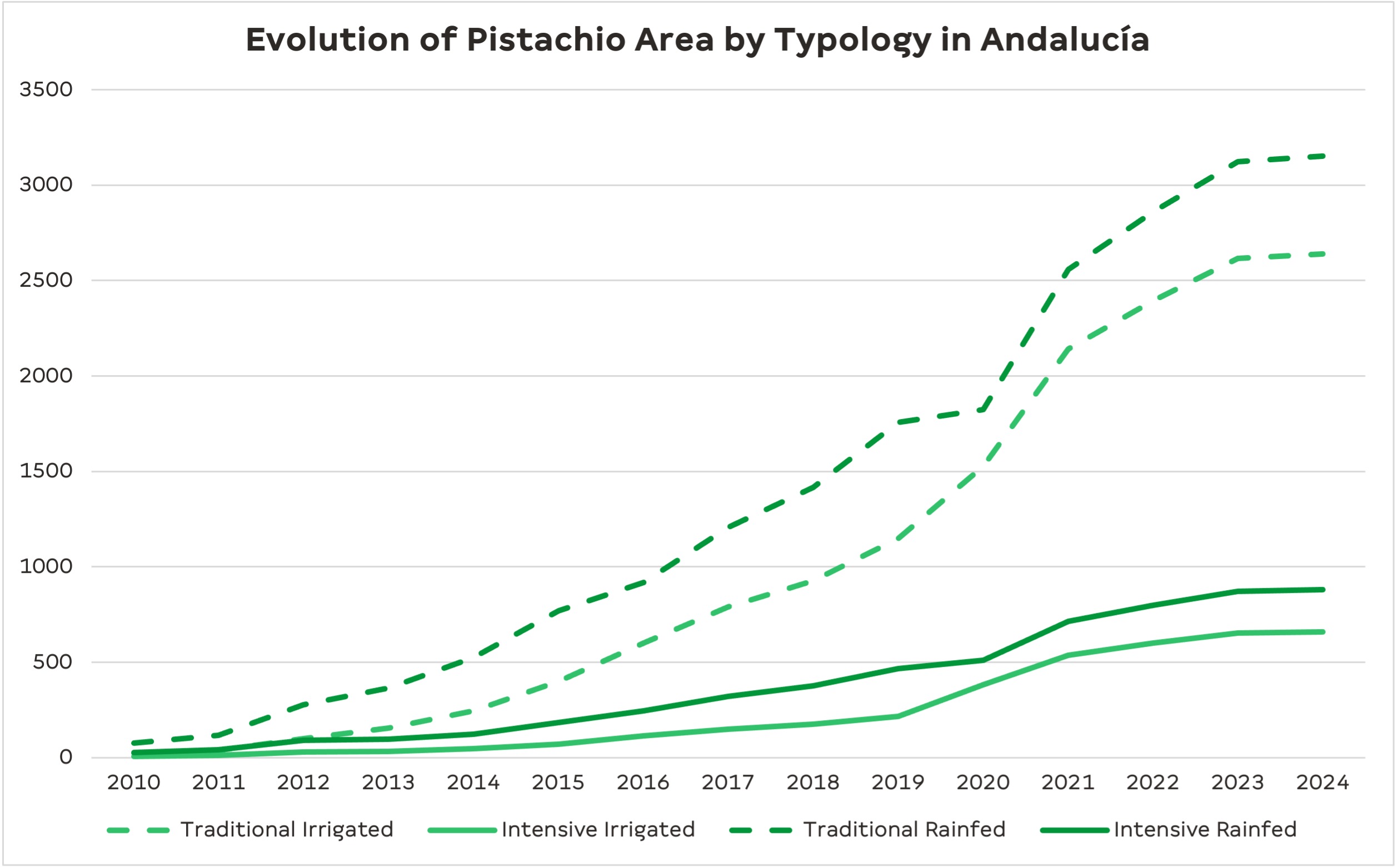
Pistachio plantations began to appear in Andalusia in 2012, when an estimated 400 hectares were under cultivation that same year. By 2024, more than 7,300 hectares had been planted.
Pistachios have positioned themselves in the region as a much more profitable alternative to olive trees than almonds.
The Larnaka variety grafted onto UCB#1 stands out above all others, as it is the best adapted to the region thanks to its low chilling requirement and its excellent-flavoured fruit.
Spain’s main agronomic advantage lies in the high quality of its water and soils, together with its lower water availability compared with other producers such as California.
This means that Spanish pistachios tend to be smaller and slightly less productive per hectare, but they offer excellent quality and flavour.
The country’s highly developed food safety standards also make Spanish pistachios a very safe product from a food quality perspective.
In addition, Spain holds a privileged position as part of the European single market, and growing international tensions around tariffs only strengthen this advantage.
Inherited from American growing practices, Kerman is the most popular variety in Spain. It was mainly planted during the 2010–2020 period.
This variety produces a very white, rounded nut, highly valued as a snack.
It is the pistachio variety with the highest chilling requirement in order to be productive, and also the one that takes the longest to come into production.
Today, the Kerman variety has been relegated to areas with a high risk of spring frost, while new plantations are being established with earlier and more productive varieties such as Sirora.
Kerman produces a rounded pistachio with a very white shell and is highly appreciated as a snack product.
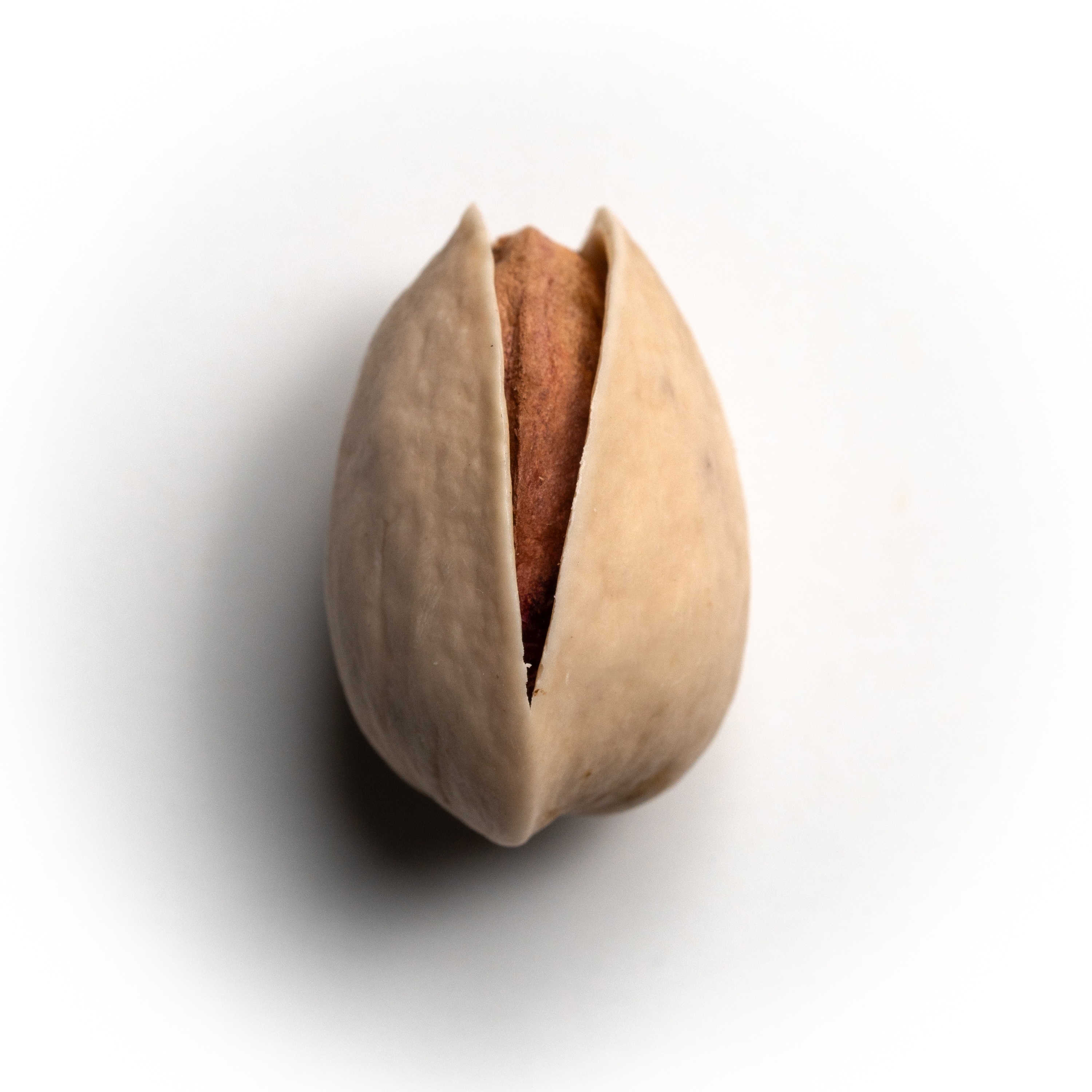
Larnaka is a very popular variety in Italy, but it is not grown in either the United States or Iran. It is gaining significant popularity in Spain due to its unique flavour and intense colour.
Larnaka produces a small, elongated pistachio with a shell marked by black speckles. Its kernel has a very intense colour and flavour.
It is the variety with the lowest chilling requirement in order to be productive, and it is also very straightforward to manage from an agronomic perspective.
This variety is becoming increasingly popular in areas with short winters, or in regions that are expected to be strongly affected by climate change.
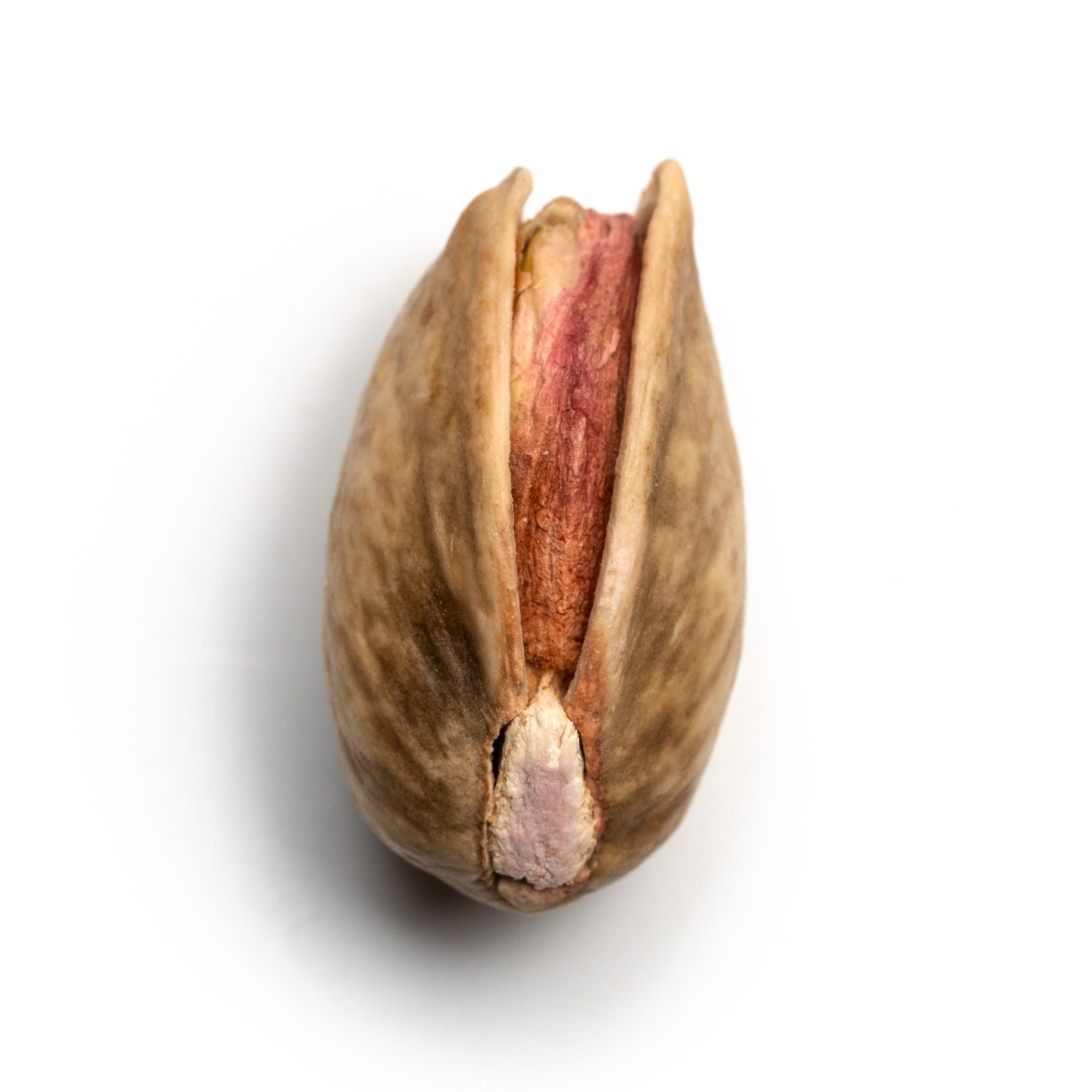
Sirora is a very popular variety in Australia that has proven to be superior to Kerman in many respects.
Its fruit is elongated, with a very white shell and a good size.
It requires less chilling than Kerman, Golden Hills or Lost Hills, and it is the variety that comes into production the fastest. In addition, it offers slightly higher yields than other varieties.
Its agronomic management is slightly different from that of other varieties.
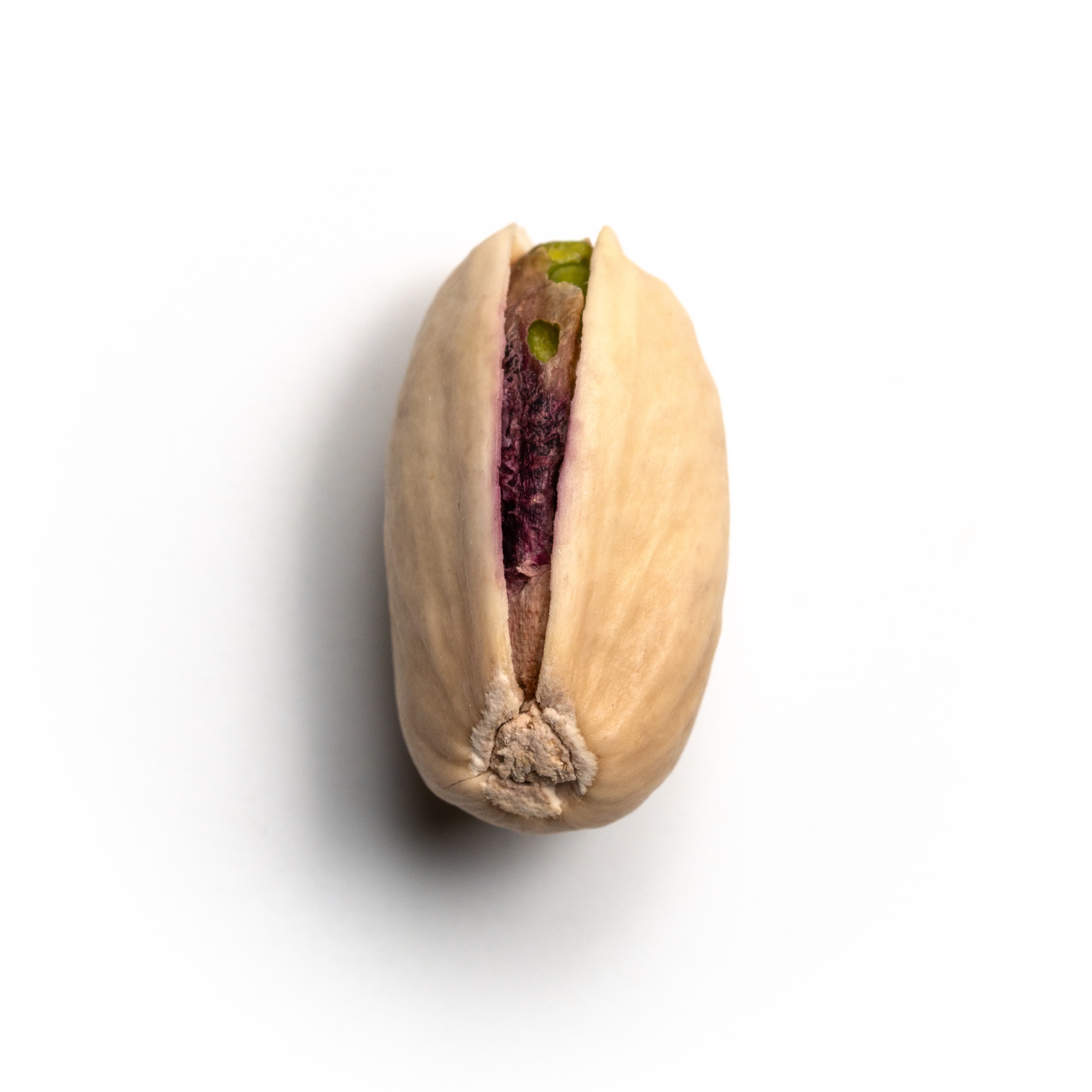
These are two varieties that were grown during the 2010–2020 period as alternatives to Kerman. However, they are now largely falling out of use, as better alternatives are available.
Kallehghoochi produces a smaller fruit than Sirora, takes longer to come into production and yields fewer kilos per plant.
Avdat produces a fruit that is very similar to Larnaka, and slightly larger, but with a much higher percentage of blanks and poorer flavour and colour. In addition, it takes longer to come into production and requires more chilling than Larnaka, making it more vulnerable to climate change and limiting the areas where it can be grown.
Today, the United States, Iran and Turkey produce 80% of the pistachios consumed worldwide. However, Turkey does not participate significantly in international markets, as it consumes most of its own production domestically.
American pistachio production is concentrated in the state of California. Sandy and sandy-loam soils predominate there, along with saline waters with a neutral pH. Water availability in the country is so high that, during rainy seasons, financial subsidies have even been offered to farmers to irrigate their fields in order to empty reservoirs and prevent potential flooding.
Agriculture is fully mechanised, and intensive and super-intensive planting systems are widespread.
The result is a large fruit, but with very poor flavour, which reaches Europe in January or February.
Spanish pistachios are smaller, but offer better flavour and are available in European markets from October onwards.
International markets recognise the limited flavour of Californian pistachios, which is why they are mainly used for roasting and salting, rather than as an ingredient.
Iran is a country with fewer resources than Spain or the United States. Iranian agriculture is not mechanised and is highly dependent on manual labour. Its trees are grown under traditional planting systems and rainfed conditions, which gives its fruit a very intense flavour.
However, the country is far behind in terms of food safety, and its pistachios do not always pass quality controls.
It is a pistachio that is similar to Spanish pistachios in terms of flavour, but far less reliable from a food safety perspective. Today, it is mainly demanded by countries with more flexible regulations than those in Europe, such as India.
For a pistachio to be considered organic, it must pass a series of tests that verify that no chemical products have been used during its production.
In Spain, most organic production is concentrated in Castilla-La Mancha, Extremadura and Andalusia. This is because these are areas with moderate rainfall levels, where rainfed cultivation is viable, but where there is not an excessive presence of pests or weeds.
This makes agronomic management easier. In general, organic pistachios are of higher quality than conventional ones, although they are more heterogeneous and smaller in size.
There is currently no major producing country specialised in organic pistachios on international markets. Spain is one of the few countries with a significant share of organic production.
Spanish pistachios stand out for their excellent flavour and high food safety standards. They are among the highest-quality pistachios in the world.
Spanish pistachios also stand out for the outstanding quality of their organic production.
Spanish pistachios are currently more expensive to produce than Iranian or American pistachios. However, they are also of higher quality, which can justify a higher price.
As the Spanish sector continues to develop and better agricultural practices are implemented, the production cost of Spanish pistachios is expected to decrease.
The varieties currently most widely planted in Spain are Kerman, Larnaka and Sirora.
Today, there are still older plantations of Avdat and Kallehghoochi, but these varieties are now largely falling out of use.
In 2024, more than 79,000 hectares of pistachios were recorded in Spain, representing 6.76% of the total area planted with pistachios worldwide.
Traditional rainfed plantations using a 6 x 6 m planting layout account for 45% of the total area, traditional irrigated plantations using the same 6 x 6 m layout represent 35%, and intensive planting systems account for the remaining 20%.

14.10.2026
9.10.2026
7.10.2026
1.07.2026