Logo
Varieties of pistachio

Varieties of pistachio

25.07.2025

Pistachio VarietiesPistachio Varieties Choosing pistachio varieties is a strategic decision that directly influences the quality and quantity of production, as well as the profitability of the agricultural project. Each variety presents distinct agronomic characteristics, with advantages and disadvantages that must be analyzed in conjunction with the climatic conditions of the area, the...

Pistachio Varieties

Pistachio Varieties


Choosing pistachio varieties is a strategic decision that directly influences the quality and quantity of production, as well as the profitability of the agricultural project.


Each variety presents distinct agronomic characteristics, with advantages and disadvantages that must be analyzed in conjunction with the climatic conditions of the area, the technical aspects of management of the plantation, and the market to which the production will be allocated.


This post describes the main pistachio varieties grown in Spain. Additionally, it details some rootstocks that enhance their characteristics. 


What to consider when choosing pistachio varieties? 

How to choose the varieties of pistachio

How to choose the varieties of pistachio.


When choosing the pistachio varieties to plant, it is necessary to take into account numerous technical and organizational variables. First, climate and soil studies should be conducted, as well as understanding the availability and quality of water and the underground water supply.


Next, a series of aspects must be considered that will also affect the efficiency of the crop. Mainly, the following:


  • Female and male varieties. The pistachio tree is a dioecious species, meaning there are varieties that only produce female flowers and others that only produce male flowers. Therefore, it is essential to select the male variety to pollinate (via wind) the female variety.
    • For example, Kerman is a widely grown female variety, typically pollinated with Peter (male).
  • Cycle of each pistachio variety. Depending on how long it takes for female varieties to bloom, they can be classified as short, medium, or long cycle. For example:
    • Larnaka and Mateur are varieties with a short dormancy period, thus blooming early. Meanwhile, Kerman and Kastel need more time to develop and bloom. Varieties such as Sirora and Lost Hill present a medium cycle. 
  • Destination market. Depending on the market to which the production will be directed, the characteristics of the pistachio offered by each variety must be considered, such as size, percentage of open fruit, and shape of the pistachio. For example:
    • If the pistachio production is intended for direct consumption, large and round fruit varieties like Kerman or Lost Hill should be chosen.
    • If the pistachio production is intended for industry, varieties with smaller fruit can be selected, such as Mateur and Larnaka.
  • Fruit size. Generally, larger fruits fetch better prices. For instance, the fruits of the Kerman variety are large and highly sought after, making their sale easy.
  • Rootstock. This is the plant that serves as the base (root system + a part of the stem) for grafting the bud of the chosen pistachio variety. It is important for improving certain characteristics of the variety, such as resistance to climate or pests.
    •  For example, one of the most commonly used rootstocks is UCB#1.


The most relevant female pistachio varieties

The most relevant female pistachio varieties

The most relevant female pistachio varieties.


The female varieties are responsible for producing the fruit, so they are usually the first plants selected. Afterwards, male varieties are chosen. 


Among the main female pistachio trees are:


Kerman


This pistachio variety originates from a selection of seeds from Iran. It is currently grown in The United States and Spain. It requires 1500 hours of cold and 3500 heat units. 


It achieves its first significant harvest in the 5th year, showing a marked tendency to alternate production, meaning it fluctuates between a good and a poor yield from one year to the next.


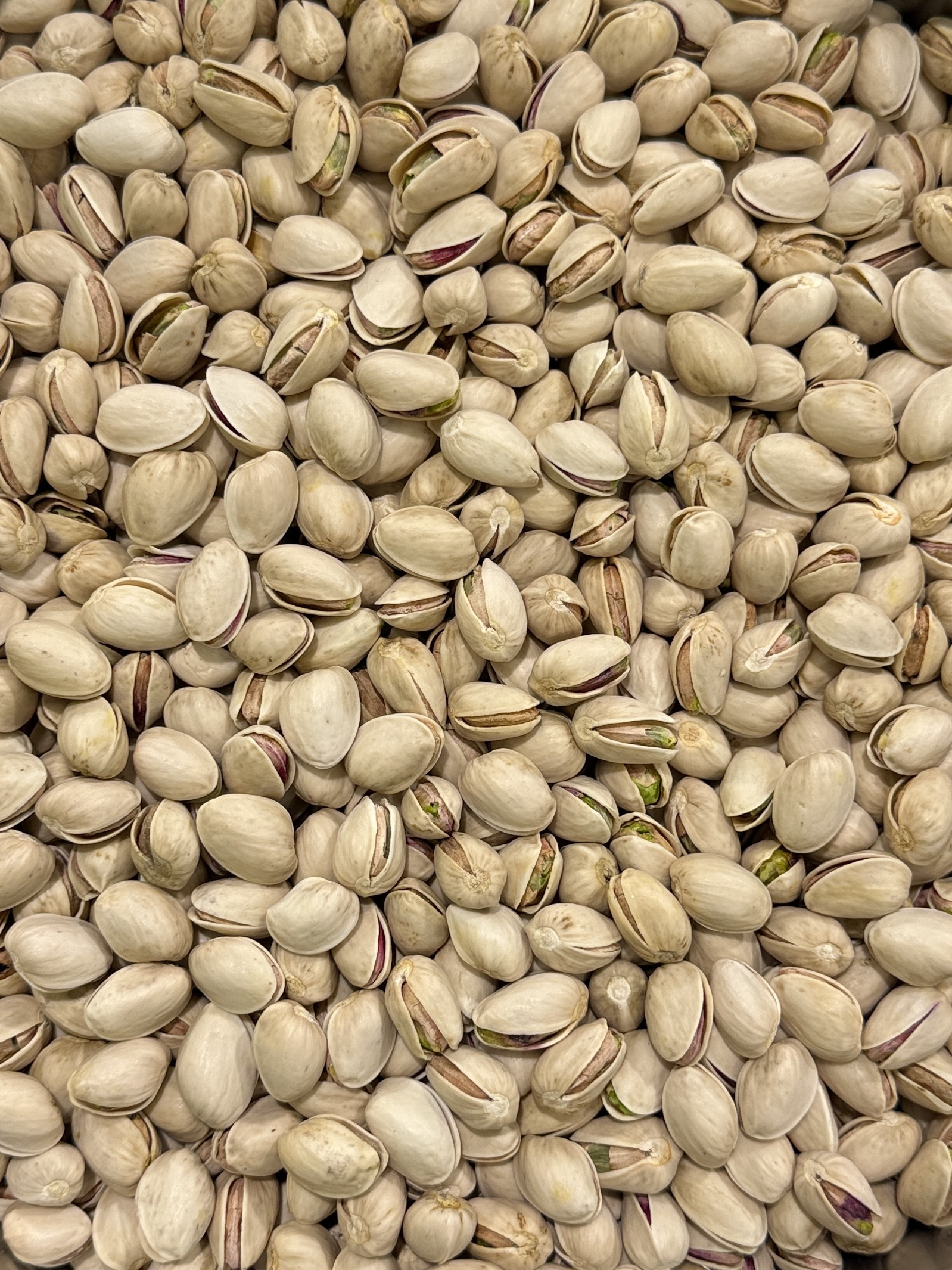
This is a medium production plant that produces high-quality fruits: large, round, with a very white shell, higher sugar content, greater consistency in the nut, and less bitterness. This makes it a highly valued variety.  


  • Blooming: late.
  • Ideal pollinator: Peter variety.
  • % of open fruits: high.
  • % of empty fruits: medium.


Sirora


This plant was created in Australia and is currently one of the most cultivated in Spain. It is characterized by high production and high vigor. It requires at least 850 hours of cold and 950 heat units. 


It is one of the ideal female varieties for dry farming due to its great resistance to dry climates, which is greater than that of other pistachio trees. Additionally, it shows rapid development, especially in the early years, which contributes to early production.


The fruit of the Sirora variety is also quite attractive and has a good flavor. Its size is medium, it has a round or elongated shape, and the whiteness of its shell is medium. 


  • Blooming: medium.
  • Pollinator: The most recommended is the C - Special variety, although the Peter variety is also used.
  • % of open fruits: high
  • % of empty fruits: medium.


Larnaka


This pistachio variety can also be cultivated under dry farming conditions. One of its main characteristics is its high level of production and its adaptability to geographical areas with few hours of cold, requiring at least around 600 hours. 


The fruit of the Larnaka variety is medium and elongated in shape. It has an excellent flavor. However, the color of the shell is less white compared to the fruit of the Sirora variety.


  • Blooming: early.
  • Pollinator: C- Special variety 
  • % of open fruits: high
  • % of empty fruits: low


Lost Hills


Lost Hills is a female pistachio variety created at the University of California (like Golden Hills). Its most prominent feature is that it has an earlier harvest than the Kerman variety.


The nuts from this pistachio tree are large, which may make them stand out in the commercial environment. However, they also tend to be more sensitive to various pistachio diseases.

 

  • Blooming: medium.
  • Pollinator: Randy variety.
  • % of open fruits: high.
  • % of empty fruits: medium.


The most relevant male pistachio varieties


All about Spanish pistachios in 10 minutes

All about Spanish pistachios in 10 minutes

24.02.2026

The Spanish pistachioAll about the Spanish pistachio in 10 minutesJoin us in this 10-minute read...
Discover everything about pistachio pruning in 15 minutes!

Discover everything about pistachio pruning in 15 minutes!

24.02.2026

The pruning of pistachios. Discover everything about pistachio pruning in 15 minutes!In this article, we...
The flowering of the pistachio

The flowering of the pistachio

9.01.2026

The flowering of pistachio in 15 minutesWe all know that plants use their flowers to...
The soil in pistachio cultivation

The soil in pistachio cultivation

7.01.2026

The soil in pistachio cultivation.After the climate, soil is the second most important element when...

Agróptimum Headquarters

Camino de las Casas de Sta. Cruz, nave 2.

16230 Villanueva de la Jara, Cuenca - España