23.07.2025
Everything about pistachios in 15 minutes
The pistachio is a nut of growing economic and nutritional importance, appreciated for its distinctive flavor, high protein content and antioxidants, and its versatility in the diet. Its characteristic green color and hard shell are its main distinguishing features, while its sustainable cultivation has boosted rural development in regions heavily affected by depopulation such as Castilla-la Mancha.
The relevance of pistachios in the global market has multiplied in recent decades: their levels of healthy fats and micronutrients make them a very beneficial food for cardiovascular and metabolic health, and their profitable cultivation favors agricultural production.
Scientific research suggests that the pistachio comes from ancient Western Asia (specifically, present-day Iran and Turkey) and that it began to be domesticated about 7,500 years ago by selecting the seeds from the largest trees and those with the most productive fruits (Kafkas, S. et al. (2022). Pistachio genomes provide insights into nut tree domestication and ZW sex chromosome evolution. Cell Reports). This crop was domesticated by the Mesopotamian and Persian civilization during antiquity and spread through the sea route and interactions with neighboring civilizations throughout the Mediterranean basin.
It is said that during the Arab Empire's invasion of the Iberian Peninsula, the Arabs cultivated the peninsula with pistachio trees to feed on their fruits. After the Reconquista, Christians cut down the male pistachio trees, as they observed that they did not bear fruit, but were unaware of their pollinating function. Over the years, due to the lack of pollen, more and more pistachio trees stopped bearing fruit until, finally, all were cut down. This incident became known as "The Arab Curse" and was due to the lack of technical knowledge about the cultivation by Christians.
It is believed that the Mesopotamian civilization was the first to domesticate the pistachio crop.
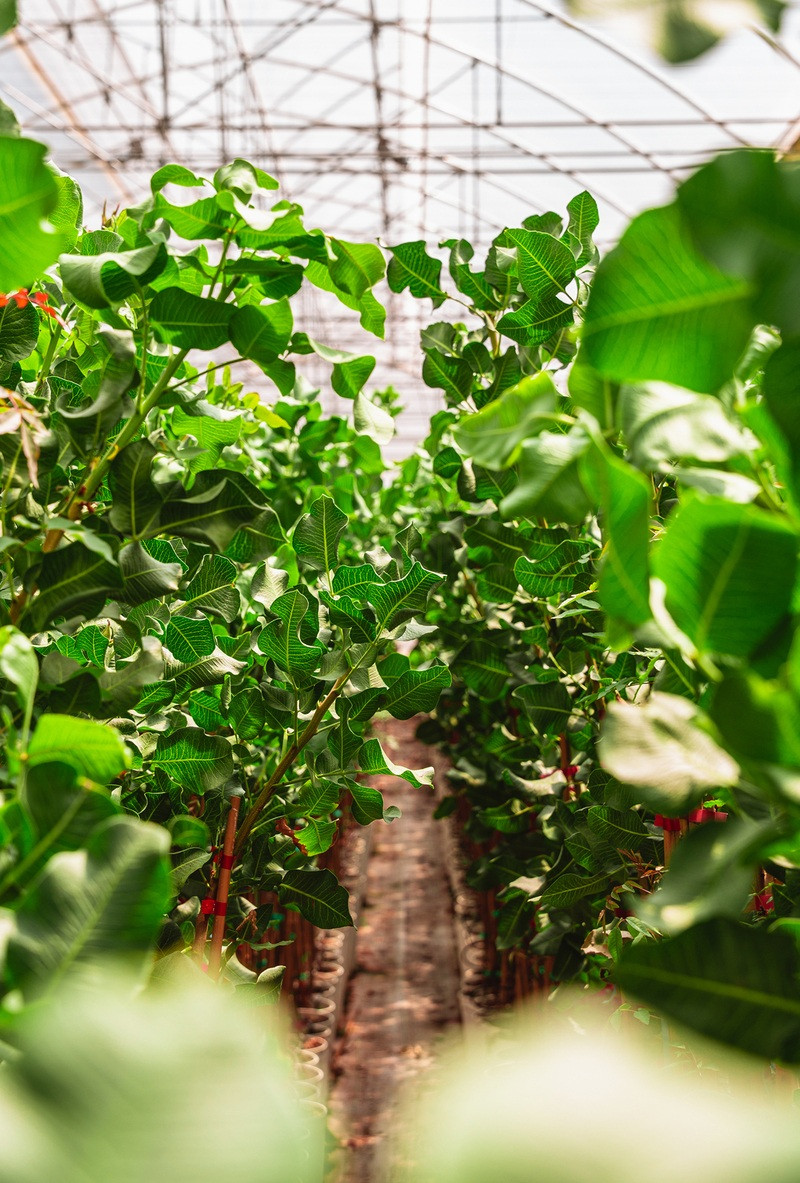
The "Pistacia Vera" tree, commonly known as the pistachio tree, is a deciduous tree that can reach heights of up to 10 meters. It has pinnate leaves and dioecious flowering (male and female trees) and requires cold winters and warm summers for proper fruit ripening. Its growth is medium to slow and it is a long-lived plant, capable of exceeding 100 years of life. Traditionally, a pistachio tree took about 8 years to reach maturity; currently, thanks to innovations in cultivation, this has been reduced to 3 years.

The pistachio tree can live for more than a century.
The pistachio is a variety that must be grafted to develop an efficient crop. The most common rootstocks to use are "Pistacia Terebinthus" (commonly known as Cornicabra), "Pistacia Atlántica," and "Pistacia UCB#1."

The UCB#1 rootstock has shown superior performance in pistachio cultivation.
This last rootstock, UCB#1, was created by the University of Davis in California and has shown superior capabilities compared to the two previous ones, as it increases the vigor of pistachio trees due to its taproot system, which allows for a greater quantity of pistachio to be produced per cultivated hectare. Additionally, it is more resistant to diseases.
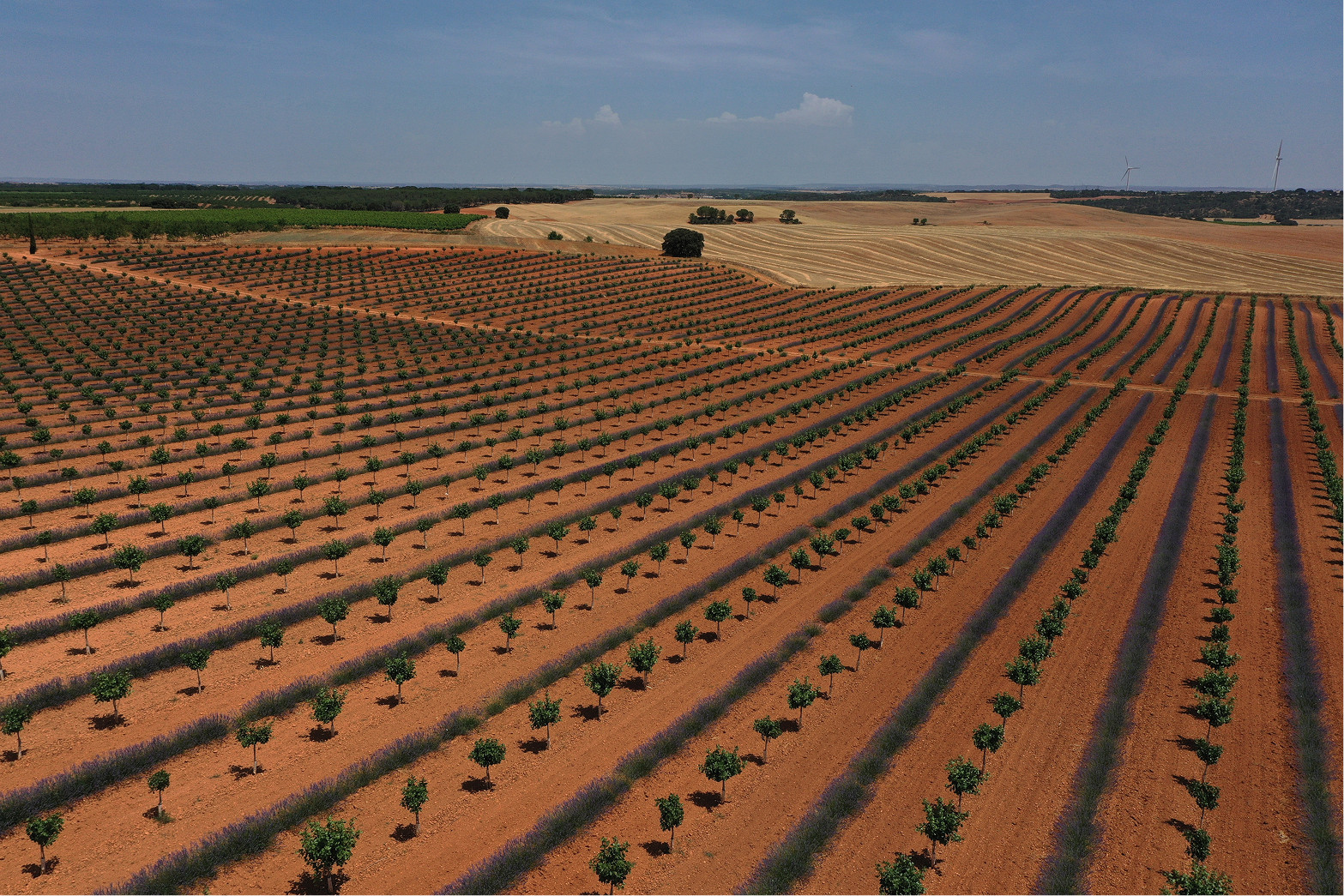
Planting in semi-intensive frameworks (5 x 3 m) is usually the most recommended in parcels with irrigation systems, while a somewhat wider framework is recommended in dryland parcels. It is a species that thrives in calcareous soils, with a pH of between 7 and 8, and exhibits a high resistance to water stress. The implementation of cover crops is a very common and advisable practice when managing the crop.
The pistachio is a dioecious species in which males must pollinate females for them to produce fruit. This is why both varieties must be included in a plantation. However, male varieties are not productive per se, meaning they cannot produce pistachios; therefore, it is advisable to keep their numbers to a minimum to fulfill their pollinating role.
In this regard, the optimal ratio usually hovers around 1 male for every 20 females, although fewer males can be used if there are other adult pistachio plantations nearby. Males should be distributed evenly throughout the plantation to optimize pollen distribution and maximize fruit setting. It is also advisable to use several male species to ensure that all female flowers have access to pollen during the pollination season.
One of the most common pests of pistachios is Agonoscena pistaciae, commonly known as the pistachio psyllid. This insect, belonging to the family "Psyllidae," deposits its eggs and inhabits the leaves of the plant, which it devours as an energy source. The presence of nymphs (young) of this specimen is associated with smaller fruit size and defoliation, stunted growth, shoot drop, and the development of sooty mold (Hassani, M. R. et al. (2009). Economic injury level of the psyllid, Agonoscena pistaciae, on pistachio, Pistacia vera cv. Ohadi. Journal of Insect Science).


1.07.2026
18.05.2026
17.05.2026
11.05.2026