13.10.2025
Modern and future agriculture: technologies, models, and opportunities in woody crops
Future agriculture is no longer a distant vision but a reality in full transformation. New agricultural production models are focused on efficiency, sustainability, and profitability, combining tradition and science with digital tools and automation.
In this context, concepts such as agriculture 4.0, digitalization of the field, or precision agriculture have moved from being experimental innovations to becoming fundamental levers of European agricultural development.
The precision agriculture relies on the use of sensors, IoT platforms, artificial intelligence (AI), and big data to collect and analyze real-time data from each plot. This information allows farmers to make informed decisions about irrigation, nutrition, treatments, or harvest, adjusting each action to the specific conditions of the soil, climate, and crop.
In woody crops —such as pistachio, olive, or almond— this evolution is particularly relevant. They are productive systems with long duration, where each technical decision has a long-term economic and environmental impact. Therefore, digitalization becomes the key to improving irrigation efficiency, reducing production costs, optimizing resource use, and increasing profitability.
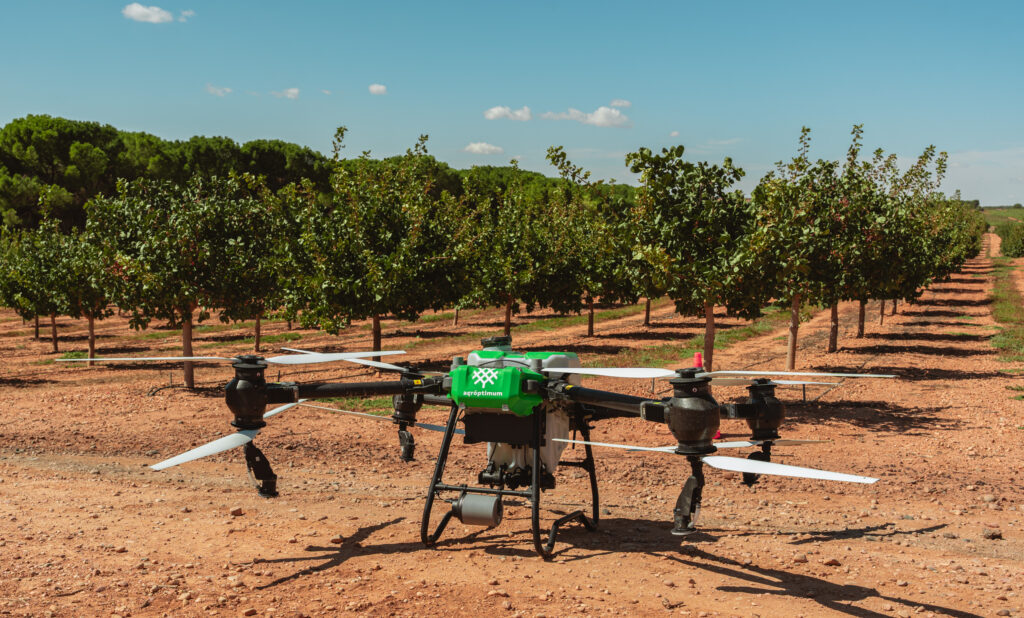
Agróptimum drone, responsible for multiple tasks such as artificial pollination.
The combination of technology and agricultural management sets the course for the sector. The application of digital platforms, drones, IoT sensors, predictive analytics, and automation is redefining the way to work in the field.
Soil and leaf moisture sensors, agroclimatic stations, and satellite remote sensing systems (NDVI) allow for controlling critical variables: water stress, foliage development, fruit growth, and nutritional status. This data, integrated into interoperable agricultural management platforms, generates a comprehensive view of the state of the farm.
Moreover, agricultural data management platforms can automate alerts on pest prediction models, nutritional deficiencies, or climate risks, improving climate resilience and water efficiency.
In the case of pistachio cultivation, the application of 4.0 technologies translates into better decision-making regarding controlled deficit irrigation, the optimal harvest time, or the management of tree vigor.
Tools for thermal and multispectral remote sensing allow for differentiating stress zones and planning specific actions. This translates into better productive performance and a more rational use of water, which is essential in continental climate areas or calcareous soils.
Each of these levers contributes to the competitiveness, sustainability, and transparency of the agricultural sector, aligning with the eco-schemes of the Common Agricultural Policy (CAP) and the objectives of the European Commission.
The basis of agriculture 4.0 is the capture and analysis of data. Thanks to rural connectivity and the Internet of Things (IoT), it is now possible to measure temperatures, humidity, radiation, flow rate, electrical conductivity, and crop growth in real time.
This data transforms into valuable information that helps farmers anticipate problems. For example, a predictive analytics system can alert to a irrigation deficit or a frost risk before the damage becomes visible.
This increases irrigation efficiency, reduces energy consumption, and improves crop profitability.
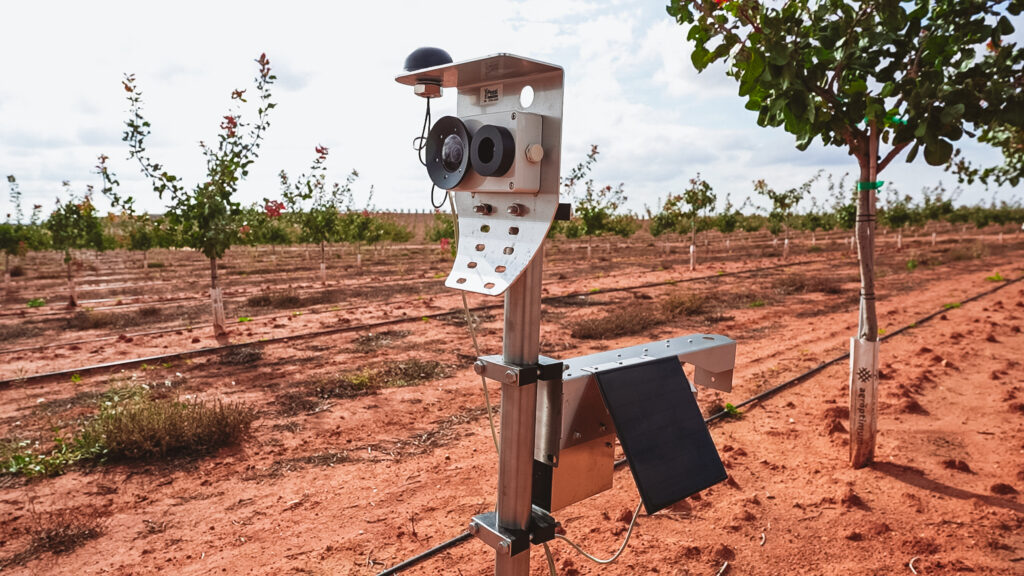
Sensors for precision agriculture
Artificial intelligence (AI) and big data process millions of data points to predict scenarios: crop development, pest spread, or the impact of climate change.
These tools are essential for achieving climate resilience, especially in long-lasting crops such as pistachio or almond.
Satellite technology (NDVI) and agricultural drones allow for obtaining vigor maps, canopy density, and moisture status. This helps to detect anomalies in vegetative development, identify stress zones, and improve fertilization and pruning planning.
Agricultural automation is transforming daily work: autonomous tractors, harvesting robots, and GPS-guided systems reduce labor costs and human errors.
In the case of pistachio, mechanized harvesting and the use of umbrellas with vibrators are already common practice in professional farms.
Controlled deficit irrigation and smart irrigation systems are pillars of modern management in arid areas. They combine soil moisture sensors, agroclimatic stations, and decision algorithms to apply water only when the tree really needs it.
This not only optimizes the water resource but also improves the quality of the fruit and the efficiency of the root system.
14.10.2026
9.10.2026
7.10.2026
1.07.2026