The grafting of pistachio: complete guide to the success of your crop
The grafting of pistachio: complete guide to the success of your crop.
The grafting process is one of the cornerstones in pistachio planting, as it ensures that the grafted plant gathers the best characteristics of the rootstock and the scion (the desired variety).
This article details step by step how to carry out the grafting correctly, with tools, professional techniques, and recommendations based on the experience of nurseries and technicians in Castilla-La Mancha and other producing areas.
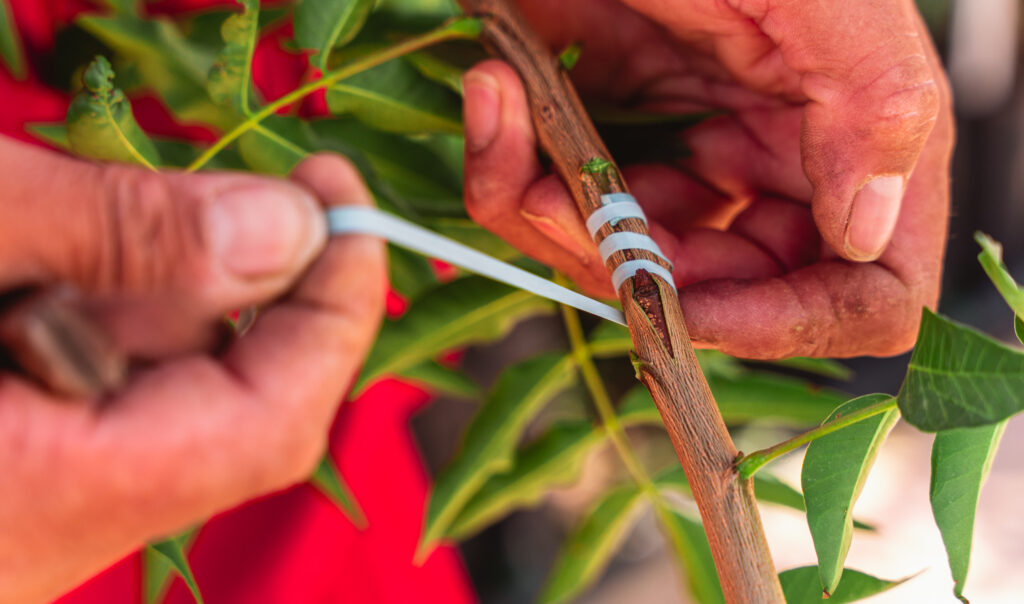
The pistachio graft carried out in the nursery.
Understanding grafting in pistachios: bases and fundamentals
Grafting in pistachio is an agronomic procedure designed to combine two components:
Rootstock: provides the root system, resistance to the ground, and adaptability to the climate and poor soils.
Scion or bud: represents the variety (such as Kerman or Sirora) that offers fruit quality, size, flavor, and yield.
This splice of plant material seeks to create a plant that combines the best of each, optimizing the balance between adaptability and quality. At Agróptimum, it is performed within the framework of a carefully managed nursery, where conditions allow for raising the technical level, ensuring success, and improving efficiency.
Why graft pistachios? Key advantages and benefits
- Robust root system: by using rootstocks like Pistacia Integerrima or UCB#1, adaptation to low-performing, saline, or water-scarce soils is reinforced.
- Genetic quality: the grafted plant expresses all the desired characteristics of the variety: size, flavor, yield, and longevity.
- Productive homogeneity: by uniforming the genetics, a consistent harvest that is easier to process and market is achieved.
- Greater long-term efficiency: the extra cost of grafting in the nursery pays off in less time due to healthier, faster, and more productive plants.
- Protection during critical phase: grafting in the nursery avoids risks from the field, such as frosts, extreme temperatures, wind, or early pest and disease attacks.
Anatomy of the graft: rootstock and scion
- Rootstock: living base that offers the plant structure. Its selection (part of the Pistacia family) determines vitality and longevity.
- Scion or bud: carrier of the genetic information that gives rise to the fruit. It must come from healthy and quality-selected trees.
- Cambium to cambium: a proper alignment and sealing ensure the connection of vascular tissues, vital for the success of the graft.
The alignment of the cambium is fundamental: when the cambium of the rootstock and the scion are correctly joined, the vascular union occurs, and the graft thrives.
In the nursery, this process is carried out with precision, controlled temperature, humidity, and technical monitoring, which favors clean and efficient healing.
Key factors for successful grafting
To ensure the success of the graft, five crucial elements must be monitored:
 High-quality plant material: healthy rootstocks and scions with firm and undamaged buds.
Constant temperature: between 18 and 25ºC, ideal for healing.
Controlled humidity: not excessive, to avoid fungi, but enough to prevent dehydration.
Rigorous hygiene: clean and disinfected tools for each cut.
Appropriate timing: just before the tree begins to sprout, preferably in the nursery to ensure total control of environmental conditions.
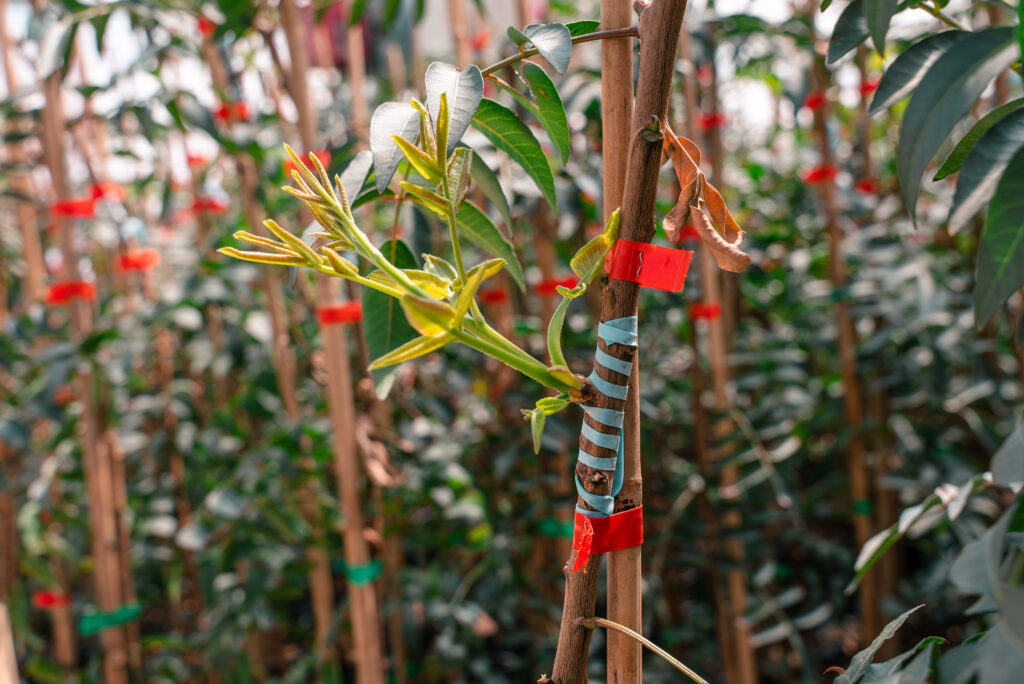
A successful pistachio graft.
Most common types of grafts in pistachios
Four main types stand out:
Bud grafting (chip bud)
- Involves inserting a single bud with bark
- Ideal for nurseries: quick, effective technique with a high success rate (greater than 85%)
- Less invasive; used on rootstocks of about 1-2cm in diameter.
Wedge grafting (simple or double)
- Cut the rootstock and create a wedge where the scion is inserted.
- High mass of united tissue and good success rate.
- Very suitable for nurseries due to its precision and control
Scion grafting (simple or double)
- Uses a scion with a wedge cut.
- Requires precise technique, allowing for a larger surface area of contact between the cambial tissues of the rootstock and the scion, which promotes take.
- Used when genetic robustness and vigor control are required.
Other types (e.g., crown)
- Used on already established trees to revitalize them or correct issues.
- Not common in nurseries but useful in the field for rescue or adaptation.
Preparation and optimal timing for grafting
Selection and preparation of rootstock
- It should have a thickness between 1.2 and 2 cm, be well-rooted and free of pathogens.
- The cut is made with a clean edge and without splinters.
Selection and preparation of scion (buds)
- Collected in winter, just before sprouting.
- Stored in the refrigerator until the moment of use.
Ideal timing for grafting pistachios in nurseries
- Season: March–April.
- Conditions: constant temperature and without water stress.
- The nursery environment eliminates common external risks found in the field, ensuring success on the first attempt.
Step-by-step guide to performing a successful graft
Detailed procedure (bud and wedge)
- Cutting the rootstock: flat and perpendicular surface to minimize vascular damage.
- Extraction of the chip/scion: clean, without splinters.
- Insertion and adjustment: carefully aligning the tissues.
- Fixation: elastic tape and protective wax over the graft.
- Labeling: record variety and date for later control.
- Allow healing
Immediate post-graft care
- Moderate and frequent watering.
- Ensure that the support of the stem prevents breakage.
- Keep the environment clean by avoiding weeds and fungi.
Post-graft care and management of the shoot
Proper watering and nutrition after grafting
- Use gentle drip irrigation that maintains moisture without suffocating the graft.
- Base fertilization with nitrogen, phosphorus, and potassium in low doses for the first months.
Pruning and training of the new shoot
- The rootstock is removed once it has sprouted and is firm.
- The shoot is trained to form the main trunk and structure of the tree.
Protection against pests and diseases
- In the nursery, the risk is low, but botrytis, powdery mildew, and aphids are monitored.
- Preventive application