23.07.2025
Complete climate guide for the pistachio tree
The climate for the pistachio tree is one of the most determining factors when planning a profitable and sustainable plantation. Although the pistachio is a resilient and adaptable crop, its levels of production, fruit quality, and resistance to pests and diseases largely depend on the climatic conditions of the environment. Precisely understanding the thermal, water, and solar exposure needs of the pistachio tree is key to maximizing its yield and ensuring efficient management, especially in a country with such climatic variability as Spain.
In this guide, we explore in detail what the ideal conditions are, what happens when the environment does not meet the optimal conditions, and how to adapt to the challenges of climate change.
Learn all about the climate of the pistachio tree
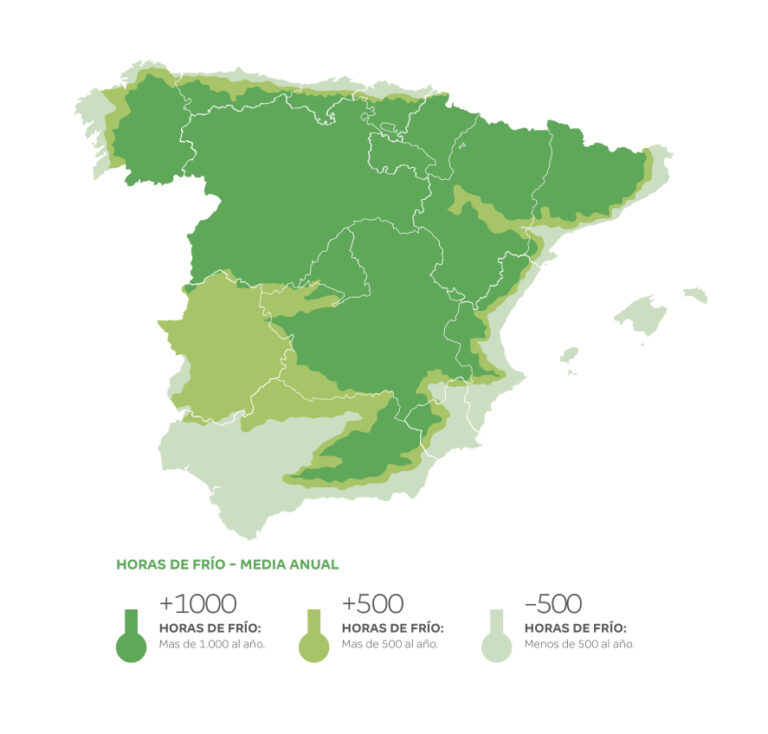
The pistachio tree needs a period of cold winters to break the dormancy of floral buds. These chilling hours (CH), accumulated below 7 °C, are essential for uniform flowering in spring.
Depending on the variety, between 800 and 1,200 CH are required. For example, Kerman needs between 1,000 and 1,200 CH, while Larnaka or Sirora, with lower requirements, can adapt to areas with 700–800 CH. A deficit of winter chill leads to irregular flowering, low production, and poor pollination.
Additionally, the need for chill also influences the synchronization between male and female flowers, vital for effective pollination. Therefore, a detailed analysis of the historical minimum temperatures is crucial to select the most appropriate variety and avoid failures in the harvest.
In addition to cold, the pistachio needs long, dry, and hot summers. This allows for proper ripening of the fruit. The development of the dry fruit depends on the accumulation of heat units or degree days (DD), especially between flowering and harvest.
It is estimated that at least 3,000 DD are required for the reproductive process and harvest to be successful. Without this accumulated heat, the number of empty or immature fruits increases. A deficit of degree days also impacts the opening of the shell, reducing the commercial quality of the pistachio.
Although the pistachio tree tolerates cold winters, late frosts in spring (after the swelling of buds) can seriously affect flowering. Temperatures below -2 °C during this phase can cause significant losses.
On the other hand, in summer, it can withstand up to 45 °C, provided there is good water management and that the soil allows it. However, excessive heat at times of pollination or ripening can also compromise the quality of the fruits. Therefore, it is important to control irrigation and promote good foliar aeration to avoid thermal stress.
The pistachio tree adapts better to areas with low relative humidity and annual rainfall below 500 mm, as long as there is irrigation available in commercial plantations.
High humidity promotes the development of pests and diseases, especially fungi such as Alternaria or Botrytis, which affect female flowers, leaves, and fruits. Therefore, a dry, sunny environment with good ventilation is ideal.
In wetter areas, it is recommended to plant on slopes with good runoff and to apply preventive fungicides. The choice of rootstocks adapted to cooler soils that favor drainage and reduce the risk of root asphyxia is also important.
Solar radiation promotes photosynthesis, growth, and the development of compounds that impact the quality and color of the dry fruit. The pistachio tree needs locations with full solar exposure, avoiding shady areas or those with prolonged orographic shadow.
Good sun exposure improves the accumulation of reserves and contributes to uniformity in ripening. Additionally, it reduces leaf moisture, which also minimizes the incidence of pests and diseases.
The ideal climate for pistachios includes:
Not all areas present these ideal conditions. In these cases, it is advisable to:
Even so, if the deviations are significant, pistachio cultivation may become unfeasible.
The local microclimate, influenced by relief, orientation, altitude

14.10.2026

9.10.2026

7.10.2026
1.07.2026